
Practical Bupropion (Wellbutrin) Tapering Guide for Adults

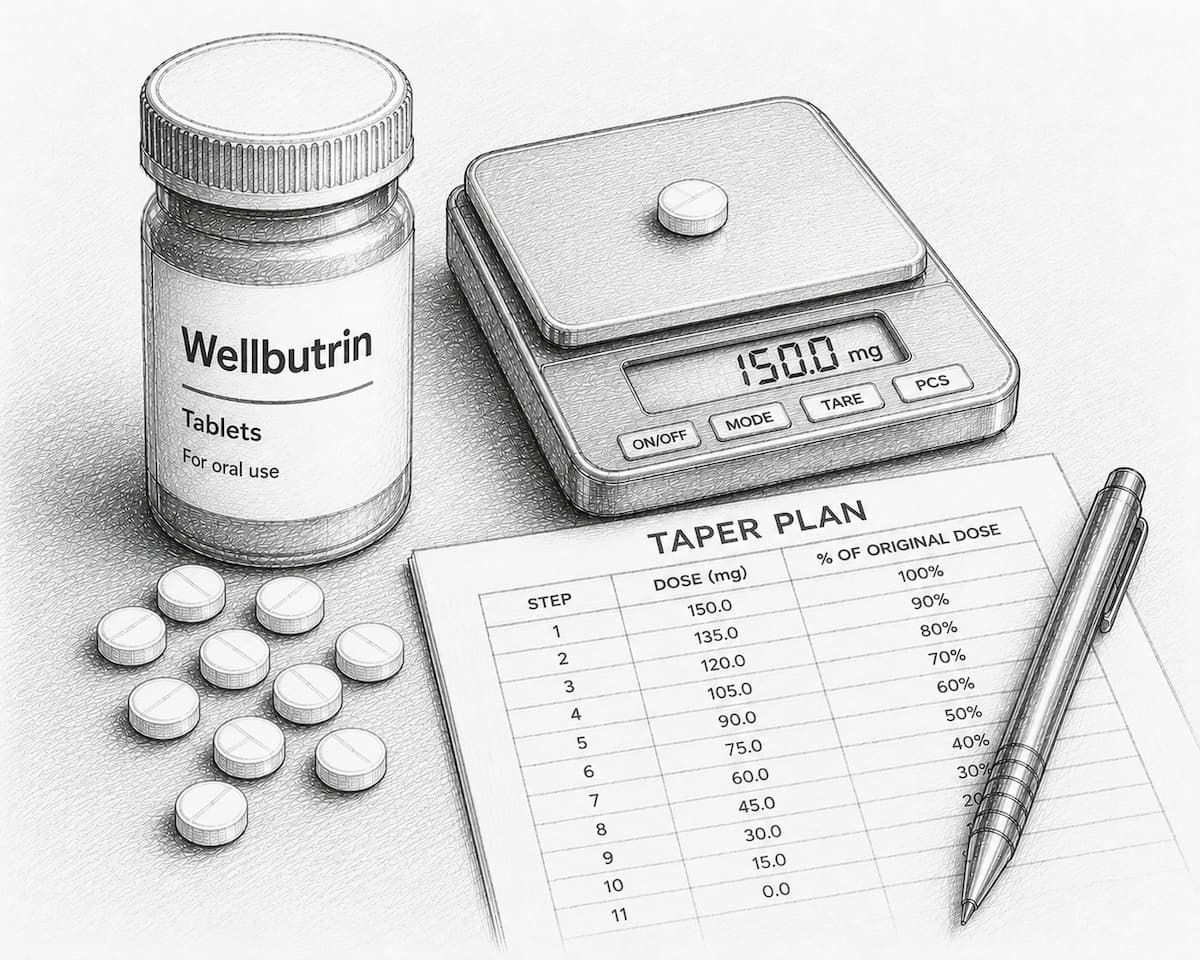
Bupropion (Wellbutrin) should generally be discontinued with the guidance of a healthcare professional, with gradual dose reductions considered according to individual circumstances. There is no single tapering schedule that will be appropriate for everyone.
Recommendations vary considerably depending on the source, while factors such as how long bupropion has been taken, the current dose, previous withdrawal experiences and the person's response to dose reductions can all influence how gradually a taper may need to proceed.
Several sources provide guidance on discontinuing bupropion and other antidepressants, ranging from the relatively brief dose-reduction instructions in U.S. prescribing information to the much more gradual, hyperbolic approaches described in the Maudsley Deprescribing Guidelines. The table below compares these approaches before we look at each one in more detail.
Bupropion Tapering Approaches at a Glance
| Source | Suggested Approach | Key Considerations |
|---|---|---|
| Maudsley Deprescribing Guidelines | Provides faster, moderate and slower hyperbolic tapering examples, with approximate durations of 5–10 months, 10–20 months and 20–40 months, respectively. Reductions are generally spaced 2–4 weeks apart. | Bupropion-specific receptor-occupancy data are lacking. The schedules are extrapolated from broader antidepressant models and are illustrative rather than validated requirements. Smaller reductions or longer intervals may be needed. |
| MedStopper | For daily use longer than 3–4 weeks, suggests an initial reduction of approximately 25% per week. The approach can be adjusted to smaller reductions and longer intervals according to individual tolerance. | Allows considerable flexibility, including reductions ranging from 1–75% at intervals of 1–50 weeks. If withdrawal becomes intolerable, suggests returning to a previously tolerated dose before proceeding more gradually. |
| Royal College of Psychiatrists | Recommends gradual, individualized antidepressant tapering. Examples include initial reductions of 25–50% or smaller reductions of approximately 5–10% for people requiring a slower approach. | Treatment duration, previous withdrawal difficulties and individual response help determine the pace. Discusses hyperbolic tapering but does not provide a bupropion-specific schedule. |
| NICE | Recommends reducing antidepressants in stages, using proportions of the previous dose. Examples include 50% reductions initially and smaller reductions, such as 25%, at lower doses. | The taper should be agreed upon and adjusted according to withdrawal symptoms. Further reductions can be delayed until symptoms have resolved or become tolerable. Not specific to bupropion. |
| NHS | Recommends gradually reducing antidepressants over several weeks or months, depending on treatment history and individual response. | Advises working with a prescriber and slowing reductions if withdrawal symptoms become troublesome. General antidepressant guidance rather than a bupropion-specific tapering protocol. |
| Canadian Product Monograph | The reviewed Bupropion HCl SR 150 mg monograph does not provide a specific tapering schedule, percentage reduction or recommended duration. | Applies to a specific Canadian SR product. Tablets must not be divided, crushed or chewed because altering their release properties can increase adverse-effect risks, including seizures. |
| U.S. Prescribing Information | U.S. bupropion XL labelling instructs reducing from 300 mg once daily to 150 mg once daily before discontinuation. | Does not specify how long to remain at 150 mg or provide a detailed taper below that dose. Applies to the XL formulation described in the prescribing information, not necessarily all bupropion products. |
Why Are These Bupropion Tapering Recommendations So Different?
There is no single universally accepted tapering schedule for bupropion. The Canadian SR product monograph does not provide a specific tapering schedule, while U.S. XL prescribing information recommends reducing from 300 mg to 150 mg before discontinuation. MedStopper offers a percentage-based approach that can be slowed if needed, while National Institute for Health and Care Excellence (NICE) and the Royal College of Psychiatrists (RCPsych) emphasize gradual, symptom-guided reductions.
The Maudsley Deprescribing Guidelines go further by providing more gradual, hyperbolic tapering examples, which are discussed in greater detail below.
These approaches should therefore be understood as different frameworks for planning a taper rather than competing prescriptions for one correct schedule.
What Do the Maudsley Deprescribing Guidelines Suggest for Tapering Bupropion?
The Maudsley Deprescribing Guidelines (Horowitz & Taylor, 2024) describe several approaches to gradually discontinuing bupropion (Wellbutrin), emphasizing that the pace of tapering should be individualized according to withdrawal symptoms, treatment duration and the person's response to each reduction.
Unlike some antidepressants, bupropion has not been extensively studied for withdrawal effects. The guidelines classify its withdrawal risk as unclear, while acknowledging published case reports of withdrawal symptoms. This means that the available evidence is insufficient to reliably establish how frequently withdrawal occurs or how severe it may be.
Maudsley also discusses the rationale for hyperbolic tapering, in which dose reductions become progressively smaller as the dose decreases. Although the relationship between drug concentration and receptor occupancy is generally hyperbolic, the authors acknowledge that direct neuroimaging data establishing bupropion's receptor-occupancy relationship are lacking. Their suggested tapering schedules are therefore informed by average trajectories for other antidepressants rather than bupropion-specific receptor-occupancy measurements.
The guidelines provide three illustrative tapering approaches, each beginning at 450 mg:
| Tapering Approach | Number of Steps | Approximate Duration |
|---|---|---|
| Faster | 11 steps | 5–10 months |
| Moderate | 21 steps | 10–20 months |
| Slower | 41 steps | 20–40 months |
These examples generally involve dose reductions every 2–4 weeks, although the guidelines acknowledge that people who have taken bupropion for only a short period may be able to discontinue more quickly. Conversely, some people may require smaller reductions and longer intervals than those illustrated.
Maudsley explicitly states that these schedules are examples rather than prescriptions. Subsequent reductions should generally occur once withdrawal symptoms from the previous reduction have largely resolved. If symptoms are persistent or difficult to tolerate, the guidelines suggest delaying further reductions, making smaller reductions, or considering a return to a previously tolerated dose before proceeding more gradually.
The guidelines also emphasize the importance of bupropion's formulation. Immediate-release (IR), sustained-release (SR) and extended-release (XL/XR) preparations have different release characteristics. Although smaller doses may sometimes be prepared using immediate-release formulations or pharmacy compounding, sustained-release and extended-release tablets should not be crushed to create smaller doses, as disrupting their release mechanisms can increase adverse-effect risks, including seizures.
What Does MedStopper Suggest for Tapering Bupropion?
MedStopper provides a practical tapering approach for bupropion (Wellbutrin). For people who have taken bupropion daily for more than 3–4 weeks, it suggests an initial reduction of approximately 25% per week.
MedStopper emphasizes that this rate can be slowed considerably when needed. It describes reductions ranging from 1–75% every 1–50 weeks, depending on how the person responds to the taper.
If intolerable withdrawal symptoms develop following a dose reduction, MedStopper suggests returning to a previously tolerated dose until symptoms resolve, before attempting a more gradual taper. Withdrawal symptoms may emerge within days of a reduction, although the timing can vary between individuals.
MedStopper lists possible withdrawal symptoms including nausea, diarrhea, abdominal pain, sweating, headache, dizziness, cold or flu-like symptoms, anxiety, irritability, difficulty sleeping, unusual sensory experiences, muscle aches and pains, chills, confusion, pounding heart (palpitations), unusual movements, mood changes, agitation, distress and restlessness. It also lists suicidal ideation as a rare possible symptom.
Importantly, MedStopper notes that the rate of discontinuation should ultimately be controlled by the person taking the medication, allowing the taper to be adjusted according to their individual response.
What Does the Canadian Product Monograph Say About Tapering Bupropion?
The Canadian product monograph for Bupropion HCl SR does not provide a specific tapering schedule, percentage reduction or recommended duration for gradually discontinuing bupropion. Although the monograph discusses stopping treatment in various clinical circumstances, it does not outline a routine dose-by-dose discontinuation protocol.
One important consideration is the medication's formulation. In Canada, bupropion is available in different formulations and strengths, with product-specific monographs outlining their respective administration instructions. The Canadian monograph reviewed here applies specifically to Bupropion HCl SR 150 mg sustained-release tablets. It explicitly instructs that these tablets must be swallowed whole and should not be divided, crushed or chewed. Altering the tablets can interfere with their controlled-release properties, potentially causing more rapid absorption and increasing the risk of adverse effects, including seizures.
The monograph also emphasizes that seizure risk is dose-dependent and identifies several factors that can increase this risk, including a history of seizures, certain eating disorders, abrupt withdrawal from alcohol or sedatives, and interactions with other medications.
These considerations are particularly relevant when planning smaller dose reductions. The progressively smaller doses illustrated in hyperbolic tapering examples cannot necessarily be achieved by dividing standard sustained-release tablets. Alternative formulations or dispensing options would need to be discussed with a prescriber and pharmacist.
The absence of a specific tapering schedule in the Canadian product monograph does not establish that gradual discontinuation is unnecessary or that withdrawal symptoms cannot occur.
What About U.S. Prescribing Information?
U.S. prescribing information for bupropion extended-release (XL) tablets provides more specific discontinuation instructions than the Canadian SR monograph reviewed above. According to the DailyMed prescribing information, patients taking 300 mg once daily should reduce to 150 mg once daily before discontinuing treatment. The labelling also describes this approach when stopping seasonal treatment for seasonal affective disorder (SAD).
However, the prescribing information does not specify how long patients should remain at 150 mg before stopping, nor does it provide a detailed schedule involving progressively smaller reductions. This represents a relatively brief, two-dose approach compared with the longer, individualized tapering examples described in The Maudsley Deprescribing Guidelines.
These U.S. instructions apply to the XL formulation and should not automatically be generalized to every bupropion product or to people who experience difficulty with withdrawal.
What Do Other Clinical Guidelines Recommend?
Royal College of Psychiatrists
The Royal College of Psychiatrists (RCPsych) recommends gradually reducing antidepressants using an individualized approach that considers treatment duration, previous withdrawal experiences and the person's response to dose reductions.
For people who have taken antidepressants for only a few weeks, RCPsych suggests that initial reductions of approximately 25–50% of the current dose every 2–4 weeks may be appropriate. However, people who have taken antidepressants for longer periods or experienced withdrawal difficulties may benefit from smaller reductions of approximately 5–10%, with further adjustments according to symptoms.
The guidance also discusses hyperbolic tapering, in which dose reductions become progressively smaller as the dose decreases. It advises against routinely skipping doses on certain days because fluctuations in medication levels may increase withdrawal symptoms.
These are general antidepressant recommendations rather than a bupropion-specific tapering protocol. The appropriate approach must also account for bupropion's sustained-release and extended-release formulations, which should not be divided or crushed to obtain smaller doses.
National Institute for Health and Care Excellence (NICE) Guidelines
The National Institute for Health and Care Excellence (NICE), in its guideline Depression in Adults: Treatment and Management (NG222), recommends gradually reducing antidepressants through a series of dose reductions rather than stopping abruptly.
NICE suggests reducing the dose by a proportion of the previous dose at each step, giving examples such as 50% reductions initially and smaller reductions of approximately 25% as the dose decreases. The pace should be agreed upon with the person taking the medication, with further reductions generally delayed until withdrawal symptoms have resolved or become tolerable.
The guidelines recognize that antidepressant withdrawal may take weeks or months and recommend monitoring for both withdrawal symptoms and the return of depressive symptoms. When withdrawal symptoms are severe, NICE suggests considering a return to the previously tolerated dose before attempting smaller, more gradual reductions.
These recommendations apply broadly to antidepressants. NICE does not provide a separate, validated tapering schedule specifically for bupropion, and the suggested percentage reductions should not be interpreted as a requirement for everyone taking Wellbutrin.
National Health Service (NHS) Guidance
The National Health Service (NHS) similarly recommends working with a prescriber to gradually discontinue antidepressants, typically over several weeks or months, depending on individual circumstances.
The NHS recognizes that withdrawal symptoms may include dizziness, headaches, nausea, sleep disturbances, anxiety, irritability and changes in mood. Although these symptoms often improve within weeks, some people experience more persistent or severe difficulties, particularly following longer-term treatment or higher doses.
For people experiencing troublesome withdrawal symptoms, NHS guidance suggests that a prescriber may recommend slowing the taper or returning to a higher dose before attempting further reductions.
The NHS does not provide a standard bupropion-specific antidepressant tapering schedule. One important distinction is that bupropion is not licensed for treating depression in the United Kingdom, although it may be prescribed off-label in certain circumstances. Consequently, the NHS recommendations discussed here should be understood as general antidepressant discontinuation guidance rather than instructions developed specifically for Wellbutrin.
What Could a Hyperbolic Taper of Bupropion Look Like?
A hyperbolic taper does not mean reducing bupropion (Wellbutrin) by the same number of milligrams at every step. Instead, the reductions generally become progressively smaller as the dose decreases, with the aim of producing smaller and more consistent changes in the medication's pharmacological effects.
The Maudsley Deprescribing Guidelines provide several illustrative bupropion tapering schedules. Unlike imipramine, these examples are not based on direct measurements of bupropion receptor occupancy but are extrapolated from broader antidepressant models. Selected doses from the moderate example illustrate how reductions can become smaller as the taper progresses:
| Selected Dose | What It Illustrates |
|---|---|
| 450 mg | Starting dose in the Maudsley example |
| 300 mg | Larger reductions toward the higher end of the dose range |
| 150 mg | Absolute dose reductions begin becoming smaller |
| 75 mg | Smaller dose changes as the taper progresses |
| 37.5 mg | Increasingly small reductions at lower doses |
| 22.5 mg | Further reductions toward the lower end |
| 1.2 mg | A very small dose near the end of the example |
| 0 mg | Final step |
Bupropion Tapering Calculator
The Maudsley example above illustrates one approach to constructing progressively smaller dose reductions. The calculator below provides another way to explore this general principle by applying a percentage reduction to the previous dose at each step. It uses a proportional percentage-based calculation rather than estimating bupropion receptor occupancy, so it should not be interpreted as reproducing the Maudsley schedules.
The calculator then generates an example schedule in which each reduction is calculated from the previous dose rather than the original starting dose. This causes the reductions to become progressively smaller as the dose decreases.
You can change the settings and regenerate the schedule to see how different reduction percentages or intervals affect the overall taper. The results are intended as an educational planning tool rather than individualized medical advice, and the calculated doses may not correspond to commercially available or practically measurable bupropion doses. In particular, sustained-release (SR) and extended-release (XL) tablets should not be divided or crushed to achieve smaller doses. Any proposed schedule should be reviewed with a prescriber and pharmacist.
Tapering Calculator
Explore how progressively smaller dose reductions can look using a percentage-based taper. Each reduction is calculated from the previous dose, rather than the original starting dose.
How Does Bupropion Work, and Why Might This Matter During Tapering?
Bupropion (Wellbutrin) is an antidepressant that differs from selective serotonin reuptake inhibitors (SSRIs) and tricyclic antidepressants. Its antidepressant effects are thought to involve norepinephrine and dopamine, two neurotransmitters involved in functions such as attention, motivation, alertness and mood. Bupropion is a relatively weak inhibitor of their reuptake and does not directly inhibit serotonin reuptake.
Bupropion is also converted in the body into several pharmacologically active metabolites, including hydroxybupropion. These metabolites contribute to the medication's overall effects and may remain in the body after the original drug has been metabolized.
One reason this may matter during tapering is that the nervous system can adapt to ongoing medication exposure. Reducing or stopping bupropion changes that exposure, potentially contributing to withdrawal symptoms in some people. However, the precise biological mechanisms responsible for bupropion withdrawal have not been established.
Although bupropion withdrawal has received considerably less research attention than withdrawal from some other antidepressants, published case reports have described symptoms such as irritability, anxiety, insomnia, headaches and generalized aches following abrupt discontinuation. These reports demonstrate that withdrawal-like reactions can occur, but they cannot establish how frequently they happen or which mechanisms are responsible.
Why Smaller Bupropion Reductions May Matter at Lower Doses
The relationship between medication dose and its effects on neurotransmitter systems is not necessarily linear. This is one reason the Maudsley Deprescribing Guidelines discuss hyperbolic tapering, in which dose reductions become progressively smaller as the dose decreases.
However, there is an important limitation with bupropion. Although human brain-imaging studies have measured dopamine transporter occupancy during treatment, these studies have not established a reliable dose–occupancy curve that can be used to design or validate a bupropion-specific hyperbolic taper.
Consequently, the Maudsley authors extrapolate their suggested bupropion tapering schedules from broader antidepressant models rather than directly measured changes in bupropion's pharmacological effects at progressively lower doses.
The rationale for smaller reductions is therefore precautionary rather than conclusively established for bupropion. Some people may tolerate relatively straightforward reductions, while others may benefit from smaller steps and longer intervals, particularly if withdrawal symptoms develop.
How to Get Smaller Bupropion Doses
One of the practical challenges of gradually tapering bupropion (Wellbutrin) is obtaining doses smaller than those available in standard tablets. This becomes particularly relevant when following a percentage-based or hyperbolic approach, where the calculated reductions may eventually involve doses that are not commercially manufactured.
In Canada, approved bupropion products include sustained-release (SR) and extended-release (XL) formulations, although the strengths available through pharmacies can vary by product. The Canadian product monograph reviewed for this article covers Bupropion HCl SR 150 mg tablets, while other approved products include XL formulations in 150 mg and 300 mg strengths.
An important limitation is that bupropion SR and XL tablets must be swallowed whole. They should not be split, crushed or chewed to obtain smaller doses, as altering their controlled-release properties can change how quickly the medication is absorbed and increase the risk of adverse effects, including seizures.
For people who require reductions smaller than commercially available tablets allow, a prescriber and pharmacist may need to consider alternative dispensing arrangements. In some circumstances, a compounding pharmacy may be able to prepare smaller doses of bupropion. However, compounded preparations are not necessarily equivalent to the original SR or XL formulation, and their availability, stability and suitability need to be assessed individually.
The Maudsley Deprescribing Guidelines discuss the potential use of immediate-release formulations and pharmacy-prepared doses when smaller reductions are needed. However, immediate-release bupropion has different release characteristics from SR and XL products, and the availability of suitable formulations varies by country. These approaches should therefore not be treated as interchangeable with standard extended-release tablets.
Although NICE recommends considering liquid preparations when very small antidepressant doses cannot be achieved using available tablets, this is general guidance and does not establish that a suitable commercially manufactured bupropion liquid is available in Canada.
Another consideration is dosing frequency. Taking bupropion every other day to achieve a lower average dose is not equivalent to taking a smaller amount each day. The Maudsley Deprescribing Guidelines caution that alternate-day dosing can create fluctuations in medication concentrations that may contribute to withdrawal symptoms.
Ultimately, the feasibility of a gradual bupropion taper depends not only on the desired reduction schedule but also on whether suitable doses and formulations can be obtained safely. A prescriber and pharmacist can help determine which options are appropriate and practically available.
What Can Affect a Bupropion Taper?
There is no single pace of tapering that will suit everyone taking bupropion. How someone responds to dose reductions can vary, and a taper may need to be adjusted along the way rather than following a predetermined schedule from beginning to end.
Factors that may influence how a bupropion taper is approached include:
- How long bupropion has been taken. Longer-term use may warrant a more gradual approach, while people who have taken an antidepressant for a relatively short period may sometimes be able to reduce more quickly.
- The current dose. Higher starting doses may require more reduction steps. Although the precise dose–occupancy relationship for bupropion has not been established, progressively smaller reductions may be useful for people who experience withdrawal difficulties at lower doses.
- Previous withdrawal experiences. Someone who has previously experienced difficult withdrawal after reducing or stopping an antidepressant may choose a more cautious approach.
- Response to each reduction. Withdrawal symptoms can provide useful information about whether the current pace is tolerable. Several guidelines recommend allowing symptoms to resolve or become manageable before making another reduction.
- Available formulations. Bupropion SR and XL tablets cannot safely be divided to obtain smaller doses. The feasibility of a gradual taper therefore depends partly on available strengths and whether suitable alternative preparations can be arranged.
- Other medications and health considerations. Bupropion is metabolized primarily through CYP2B6, and other medications may affect its metabolism or interact with its effects. Bupropion also carries a dose-dependent seizure risk, making a history of seizures, certain eating disorders, abrupt withdrawal from alcohol or sedatives, and other seizure-threshold-lowering medications particularly important considerations.
- Life circumstances and support. Stress, sleep disruption, major life changes and the availability of practical or emotional support may also affect how manageable the tapering process feels.
A tapering plan therefore does not necessarily need to remain unchanged once it has begun. Holding at a dose for longer, making a smaller next reduction or otherwise adjusting the pace in response to symptoms and circumstances can all be part of an individualized tapering process.
Bupropion Withdrawal Symptoms
Withdrawal symptoms have been reported following the reduction or discontinuation of bupropion (Wellbutrin), although research examining their frequency, severity and duration remains limited. The Maudsley Deprescribing Guidelines classify bupropion's withdrawal risk as unclear, while acknowledging published case reports documenting symptoms following discontinuation.
Symptoms described in published case reports and broader antidepressant withdrawal resources, including MedStopper, include physical, gastrointestinal, sleep-related and psychological difficulties. Not every symptom listed below has been independently established as a bupropion-specific withdrawal effect.
The following table summarizes possible symptoms that may occur during antidepressant discontinuation, including those reported in connection with bupropion.
| Symptom Category | Possible Withdrawal Symptoms |
|---|---|
| Gastrointestinal & Autonomic | Nausea, diarrhea, abdominal discomfort, sweating, chills, pounding heart (palpitations) |
| Neurological & Physical | Headache, dizziness, flu-like symptoms, muscle aches, unusual sensory experiences, tremors or unusual movements |
| Sleep | Difficulty sleeping (insomnia), disturbed sleep |
| Mood & Cognitive | Anxiety, irritability, agitation, restlessness, mood changes, distress, confusion |

Looking for a more in-depth resource? The Harm Reduction Guide to Coming Off Psychiatric Drugs by Will Hall offers a harm-reduction perspective on psychiatric medications, withdrawal, and making informed decisions about coming off medications.
The guide is available free through Fireweed Collective and has been translated into multiple languages.
Frequently Asked Questions About Tapering Bupropion (Wellbutrin)
How Can I Tell Bupropion Withdrawal From a Return of the Original Condition?
Distinguishing bupropion (Wellbutrin) withdrawal from a return of depression or another condition can be difficult because symptoms such as anxiety, irritability, sleep disturbances and changes in mood may overlap.
Withdrawal symptoms may emerge relatively soon after a dose reduction or discontinuation, sometimes alongside physical symptoms that were not part of the original condition. A return of depression may develop more gradually, although these patterns are not always reliable.
The NICE guidelines recommend considering the timing and nature of symptoms when assessing possible antidepressant withdrawal. Tracking symptoms alongside dose changes and discussing them with a healthcare professional may help distinguish withdrawal from recurrence.
What If Withdrawal Symptoms Increase During a Bupropion Taper?
If withdrawal symptoms become difficult to tolerate, it may be appropriate to pause further reductions rather than continuing with a predetermined schedule.
The Maudsley Deprescribing Guidelines recommend allowing withdrawal symptoms to largely resolve before making another reduction. NICE similarly advises waiting until symptoms have resolved or become tolerable before proceeding.
Depending on the severity of symptoms, a prescriber may recommend holding the current dose longer, making smaller subsequent reductions or considering a return to a previously tolerated dose before attempting a more gradual taper.
Severe mood deterioration, suicidal thoughts, seizures or other serious symptoms require prompt medical assessment.
How Long Does It Take to Taper Bupropion?
There is no single established duration for tapering bupropion. The appropriate timeframe depends on factors such as treatment duration, current dose, previous withdrawal experiences and the person's response to reductions.
U.S. prescribing information for bupropion XL recommends reducing from 300 mg to 150 mg before discontinuation but does not specify how long to remain at the lower dose.
The Maudsley Deprescribing Guidelines provide illustrative schedules ranging from approximately 5–10 months to 20–40 months, depending on the approach. However, these are extrapolated examples rather than clinically validated requirements, and some people may discontinue considerably faster.
The aim is not necessarily to follow a particular timeline but to find a pace that is appropriate and tolerable for the individual.
What Is the Lowest Dose of Bupropion?
The lowest commercially available bupropion dose depends on the country, formulation and specific product.
In Canada, approved bupropion products include 150 mg sustained-release (SR) tablets and 150 mg and 300 mg extended-release (XL) tablets. Some 100 mg SR products appear in Health Canada's Drug Product Database but have been cancelled and should not be assumed to be currently available.
In the United States, 75 mg immediate-release (IR) tablets are also available, along with other strengths and formulations.
Lower doses may sometimes be obtained through specialized pharmacy preparations, but these are not necessarily equivalent to commercially manufactured SR or XL products. A pharmacist can help clarify which formulations and strengths are actually available.
Can Bupropion Tablets Be Split?
Bupropion sustained-release (SR) and extended-release (XL) tablets should not be split, crushed or chewed.
These formulations are designed to release medication gradually. Dividing or crushing them can interfere with their release characteristics, potentially causing more rapid absorption and increasing the risk of adverse effects, including seizures.
Both Canadian product monographs and U.S. prescribing information emphasize that SR and XL tablets should be swallowed whole.
People who need smaller doses should discuss appropriate alternatives with their prescriber and pharmacist rather than modifying these tablets themselves.
Can You Take Bupropion Every Other Day When Tapering?
Every-other-day dosing is generally not recommended as a routine method of tapering bupropion.
Skipping days creates fluctuations in medication exposure rather than providing a consistent, gradually decreasing daily dose. The Maudsley Deprescribing Guidelines caution that alternate-day bupropion dosing may contribute to withdrawal symptoms because of these fluctuations.
Although bupropion has active metabolites that remain in the body longer than the parent medication, this does not establish that alternate-day dosing is a suitable tapering strategy.
A more consistent approach is generally to reduce the amount taken each day while maintaining regular dosing intervals, where an appropriate formulation is available. Any changes to the dosing schedule should be discussed with a prescriber or pharmacist.
References
- Bausch Health Companies Inc. Bupropion HCl SR: Canadian Product Monograph. Health Canada.
- Berigan, T. R., & Harazin, J. S. (1999). Bupropion-associated withdrawal symptoms: A case report. Primary Care Companion to The Journal of Clinical Psychiatry, 1(2), 50–51.
- Berigan, T. R. (2002). Bupropion-associated withdrawal symptoms revisited: A case report. Primary Care Companion to The Journal of Clinical Psychiatry, 4(2), 78.
- Henssler, J., Heinz, A., Brandt, L., & Bschor, T. (2019). Antidepressant withdrawal and rebound phenomena. Deutsches Ärzteblatt International, 116, 355–361.
- Horowitz, M. A., & Taylor, D. (2019). Tapering of SSRI treatment to mitigate withdrawal symptoms. The Lancet Psychiatry, 6(6), 538–546.
- Horowitz, M., & Taylor, D. M. (2024). The Maudsley Deprescribing Guidelines: Antidepressants, Benzodiazepines, Gabapentinoids and Z-Drugs. Wiley-Blackwell.
- Learned-Coughlin, S. M., Bergström, M., Savitcheva, I., Ascher, J., Schmith, V. D., & Långström, B. (2003). In vivo activity of bupropion at the human dopamine transporter as measured by positron emission tomography. Biological Psychiatry, 54(8), 800–805.
- MedStopper. (n.d.). MedStopper: A Tool to Help Patients and Prescribers Stop Medications.
- National Health Service. (n.d.). Antidepressants.
- National Institute for Health and Care Excellence. (2022). Depression in Adults: Treatment and Management (NG222). Recommendations on stopping antidepressant medication.
- National Library of Medicine. Bupropion Hydrochloride Extended-Release Tablets (XL): U.S. Prescribing Information. DailyMed.
- Royal College of Psychiatrists. (n.d.). Stopping Antidepressants.
This article is intended for educational purposes only and should not be considered medical advice. Psychiatric medication tapering should be discussed with a qualified healthcare professional familiar with your medical history and current circumstances. Withdrawal experiences can vary significantly between individuals. Information on this website is not intended to diagnose, treat, or replace individualized medical or psychiatric care. If you are experiencing severe symptoms, worsening mental health, or thoughts of self-harm, seek immediate medical attention or contact emergency services.